Posted by MiriamEllis

No marketing agency staffer feels good when they see a retail client getting reviews like this on the web.
But we can find out why they’re happening, and if we’re going above-and-beyond in our work, we just might be able to catalyze turning things around if we’re committed to being honest with clients and have an actionable strategy for their in-store improvements.
In this post, I’ll highlight some advice from an internal letter at Tesla that I feel is highly applicable to the retail sector. I’d also like to help your agency combat the retail blues headlining the news these days with big brands downsizing, liquidating and closing up shop — I’m going to share a printable infographic with some statistics with you that are almost guaranteed to generate the client positivity so essential to making real change. And, for some further inspiration, I’d like to offer a couple of anecdotes involving an Igloo cooler, a monk, reindeer moss, and reviews.
The genuine pain of retail gone wrong: The elusive cooler, "Corporate," and the man who could hardly stand
“Hi there,” I greeted the staffer at the customer service counter of the big department store. “Where would I find a small cooler?”
“We don’t have any,” he mumbled.
“You don’t have any coolers? Like, an Igloo cooler to take on a picnic to keep things cold?”
“Maybe over there,” he waved his hand in unconcern.
And I stood there for a minute, expecting him to actually figure this out for me, maybe even guide me to the appropriate aisle, or ask a manager to assist my transaction, if necessary. But in his silence, I walked away.
“Hi there,” I tried with more specificity at the locally owned general store the next day. “Where would I find something like a small Igloo cooler to keep things cold on a picnic?”
“I don’t know,” the staffer replied.
“Oh…” I said, uncomfortably.
“It could be upstairs somewhere,” he hazarded, and left me to quest for the second floor, which appeared to be a possibly-non-code-compliant catch-all attic for random merchandise, where I applied to a second dimly illuminated employee who told me I should probably go downstairs and escalate my question to someone else.
And apparently escalation was necessary, for on the third try, a very tall man was able to lift his gaze to some coolers on a top shelf… within clear view of the checkout counter where the whole thing began.
Why do we all have experiences like this?
“Corporate tells us what to carry” is the almost defensive-sounding refrain I have now received from three employees at two different Whole Foods Markets when asking if they could special order items for me since the Amazon buyout.
Because, you know, before they were Amazon-Whole Foods, staffers would gladly offer to procure anything they didn’t have in stock. Now, if they stop carrying that Scandinavian vitamin D-3 made from the moss eaten by reindeer and I’ve got to have it because I don’t want the kind made by irradiating sheep wool, I’d have to special order an entire case of it to get my hands on a bottle. Because, you know, “Corporate.”
Why does the distance between corporate and customer make me feel like the store I’m standing in, and all of its employees, are powerless? Why am I, the customer, left feeling powerless?
So maybe my search for a cooler, my worries about access to reindeer moss, and the laughable customer service I’ve experienced don’t signal “genuine pain.” But this does:

This is genuine pain. When customer service is failing to the point that badly treated patrons are being further distressed by the sight of fellow shoppers meeting the same fate, the cause is likely built into company structure. And your marketing agency is looking at a bonafide reputation crisis that could presage things like lawsuits, impactful reputation damage, and even closure for your valuable clients.
When you encounter customer service disasters, it begs questions like:
- Could no one in my situation access a list of current store inventory, or, barring that, seek out merchandise with me instead of risking the loss of a sale?
- Could no one offer to let “corporate” know that I’m dissatisfied with a “customer service policy” that would require me to spend $225 to buy a whole case of vitamins? Why am I being treated like a warehouse instead of a person?
- Could no one at the pharmacy see a man with a leg wound about to fall over, grab a folding chair for him, and keep him safe, instead of risking a lawsuit?
I think a “no” answer to all three questions proceeds from definite causes. And I think Tesla CEO, Elon Musk, had such causes in mind when he recently penned a letter to his own employees.
“It must be okay for people to talk directly and just make the right thing happen.”
“Communication should travel via the shortest path necessary to get the job done, not through the 'chain of command.' Any manager who attempts to enforce chain of command communication will soon find themselves working elsewhere.
A major source of issues is poor communication between depts. The way to solve this is allow free flow of information between all levels. If, in order to get something done between depts, an individual contributor has to talk to their manager, who talks to a director, who talks to a VP, who talks to another VP, who talks to a director, who talks to a manager, who talks to someone doing the actual work, then super dumb things will happen. It must be ok for people to talk directly and just make the right thing happen.
In general, always pick common sense as your guide. If following a 'company rule' is obviously ridiculous in a particular situation, such that it would make for a great Dilbert cartoon, then the rule should change.”
- Elon Musk, CEO, Tesla
Let’s parlay this uncommon advice into retail. If it’s everyone’s job to access a free flow of information, use common sense, make the right thing happen, and change rules that don’t make sense, then:
- Inventory is known by all store staff, and my cooler can be promptly located by any employee, rather than workers appearing helpless.
- Employees have the power to push back and insist that, because customers still expect to be able to special order merchandise, a specific store location will maintain this service rather than disappoint consumers.
- Pharmacists can recognize that patrons are often quite ill and can immediately place some chairs near the pharmacy counter, rather than close their eyes to suffering.
“But wait,” retailers may say. “How can I trust that an employee’s idea of ‘common sense’ is reliable?”
Let’s ask a monk for the answer.
“He took the time...”
I recently had the pleasure of listening to a talk given by a monk who was defining what it meant to be a good leader. He hearkened back to his young days, and to the man who was then the leader of his community.
“He was a busy man, but he took the time to get to know each of us one-on-one, and to be sure that we knew him. He set an example for me, and I watched him,” the monk explained.
Most monasteries function within a set of established rules, many of which are centuries old. You can think of these guidelines as a sort of policy. In certain communities, it’s perfectly acceptable that some of the members live apart as hermits most of the year, only breaking their meditative existence by checking in with the larger group on important holidays to share what they’ve been working on solo. In others, every hour has its appointed task, from prayer, to farming, to feeding people, to engaging in social activism.
The point is that everyone within a given community knows the basic guidelines, because at some point, they’ve been well-communicated. Beyond that, it is up to the individual to see whether they can happily live out their personal expression within the policy.
It’s a lot like retail can be, when done right. And it hinges on the question:
“Has culture been well-enough communicated to every employee so that he or she can act like the CEO of the company would in wide variety of circumstances?”
Or to put it another way, would Amazon owner Jeff Bezos be powerless to get me my vitamins?
The most accessible modern benchmark of good customer service — the online review — is what tells the public whether the CEO has “set the example.” Reviews tell whether time has been taken to acquaint every staffer with the business that employs them, preparing them to fit their own personal expression within the company’s vision of serving the public.
An employee who is able to recognize that an injured patron needs a seat while awaiting his prescription should be empowered to act immediately, knowing that the larger company supports treating people well. If poor training, burdensome chains of command, or failure to share brand culture are obstacles to common-sense personal initiative, the problem must be traced back to the CEO and corrected, starting from there.
And, of course, should a random staffer’s personal expression genuinely include an insurmountable disregard for other people, they can always be told it’s time to leave the monastery...
For marketing agencies, opportunity knocks
So your agency is auditing a valuable incoming client, and their negative reviews citing dirty premises, broken fixtures, food poisoning, slowness, rudeness, cluelessness, and lack of apparent concern make you say to yourself,
“Well, I was hoping we could clean up the bad data on the local business listings for this enterprise, but unless they clean up their customer service at 150 of their worst-rated locations, how much ROI are we really going to be able to deliver? What’s going on at these places?”
Let’s make no bones about this: Your honesty at this critical juncture could mean the difference between survival and closure for the brand.
You need to bring it home to the most senior level person you can reach in the organization that no amount of honest marketing can cover up poor customer service in the era of online reviews. If the brand has fallen to the level of the pharmacy I’ve cited, structural change is an absolute necessity. You can ask the tough questions, ask for an explanation of the bad reviews.
“But I’m just a digital marketer,” you may think. “I’m not in charge of whatever happens offline.”
Think again.
Headlines in retail land are horrid right now:
- The mall crisis is secretly morphing into a full-on Armageddon - Business Insider
- America’s ‘Retail Apocalypse’ Is Really Just Beginning - Bloomberg
- Retail Wreck? Over 1,000 Stores Close in a Single Week - NBC
- 8 Companies Amazon is Killing - Investopedia
- These major retailers have closed more than 5,000 stores in 2017 - Clark.com
If you were a retail brand C-suite and were swallowing these predictions of doom with your daily breakfast, wouldn’t you be looking for inspiration from anyone with genuine insight? And if a marketing agency should make it their business to confront the truth while also being the bearer of some better news, wouldn’t you be ready to listen?
What is the truth? That poor reviews are symptoms smart doctors can use for diagnosis of structural problems.
What is the better news? The retail scenario is not nearly as dire as it may seem.
Why let hierarchy and traditional roles hold your agency back? Tesla wouldn’t. Why not roll up your sleeves and step into in-store? Organize and then translate the narrative negative reviews are telling about structural problems for the brand which have resulted in dangerously bad customer service. And then, be prepared to counter corporate inertia born of fear with some eye-opening statistics.
Print and share some good retail tidings
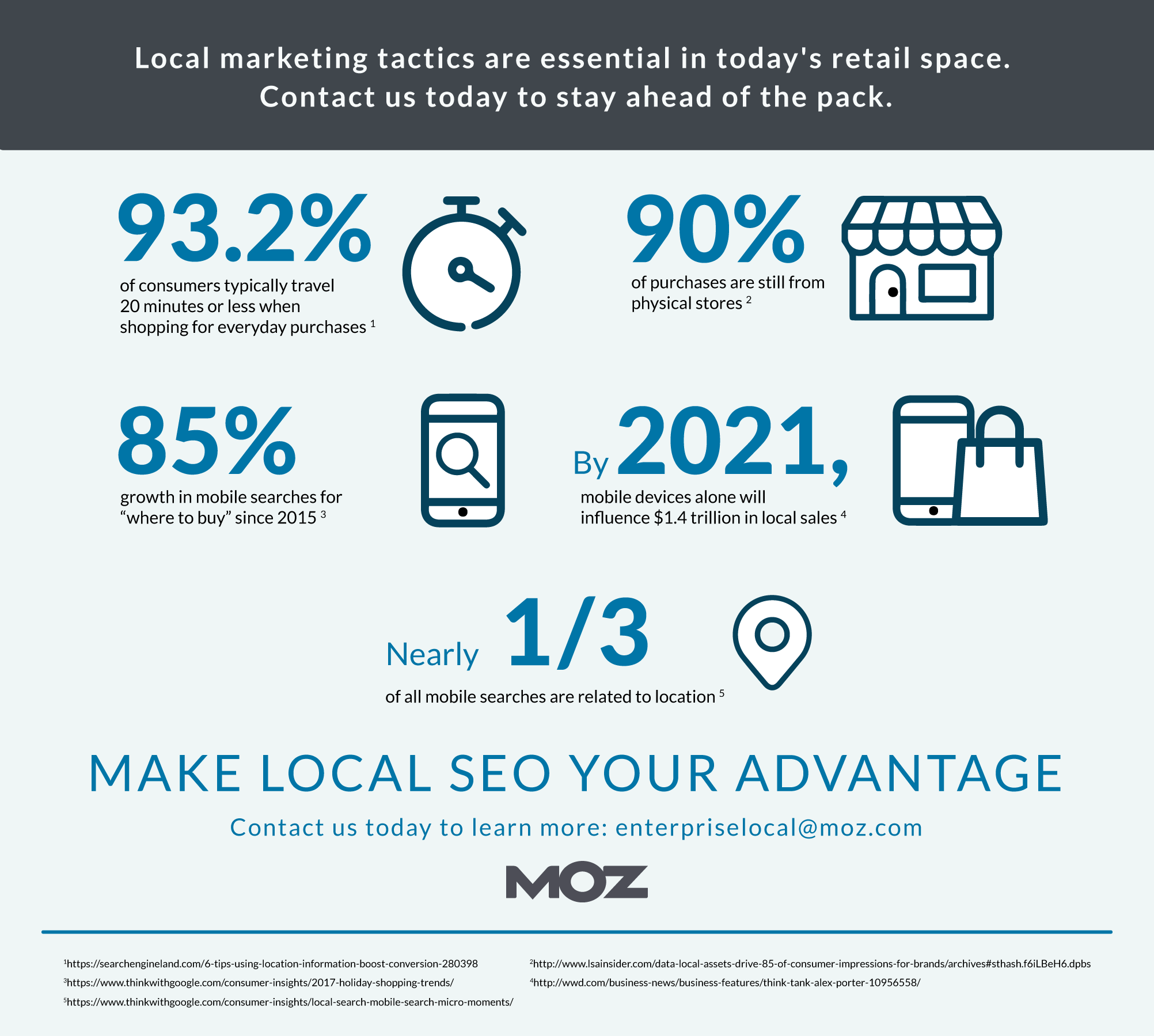
Print your own copy of this infographic to share with clients.
At Moz, we’re working with enterprises to get their basic location data into shape so that they are ready to win their share of the predicted $1.4 trillion in mobile-influenced local sales by 2021, and your agency can use these same numbers to combat indecision and apathy for your retail clients. Look at that second statistic again: 90% of purchases are still happening in physical stores. At Moz, we ask our customers if their data is ready for this. Your agency can ask its clients if their reputations are ready for this, if their employees have what they need to earn the brand’s piece of that 90% action. Great online data + great in-store service = table stakes for retail success.
While I won’t play down the unease that major brand retail closures is understandably causing, I hope I’ve given you the tools to fight the “retail disaster” narrative. 85% more mobile users are searching for things like “Where do I buy that reindeer moss vitamin D3?” than they were just 3 years ago. So long as retail staff is ready to deliver, I see no “apocalypse” here.
Investing time
So, your agency has put in the time to identify a reputation problem severe enough that it appears to be founded in structural deficiencies or policies. Perhaps you’ve used some ORM software to do review sentiment analysis to discover which of your client’s locations are hurting worst, or perhaps you’ve done an initial audit manually. You've communicated the bad news to the most senior-level person you can reach at the company, and you've also shared the statistics that make change seem very worthwhile, begging for a new commitment to in-store excellence. What happens next?
While there are going to be nuances specific to every brand, my bet is that the steps will look like this for most businesses:
- C-suites need to invest time in creating a policy which a) abundantly communicates company culture, b) expresses trust in employee initiative, and c) dispenses with needless “chain of command” steps, while d) ensuring that every public facing staffer receives full and ongoing training. A recent study says 62% of new retail hires receive less than 10 hours of training. I’d call even these worrisome numbers optimistic. I worked at 5 retail jobs in my early youth. I’d estimate that I received no more than 1 hour of training at any of them.
- Because a chain of command can’t realistically be completely dispensed with in a large organization, store managers must then be allowed the time to communicate the culture, encourage employees to use common sense, define what “common sense” does and doesn’t look like to the company, and, finally, offer essential training.
- Employees at every level must be given the time to observe how happy or unhappy customers appear to be at their location, and they must be taught that their observations are of inestimable value to the brand. If an employee suggests a solution to a common consumer complaint, this should be recognized and rewarded.
- Finally, customers must be given the time to air their grievances at the time of service, in-person, with accessible, responsive staff. The word “corporate” need never come into most of these conversations unless a major claim is involved. Given that it may cost as much as 7x more to replace an unhappy customer than to keep an existing one happy, employees should be empowered to do business graciously and resolve complaints, in most cases, without escalation.
Benjamin Franklin may or may not have said that “time is money.” While the adage rings true in business, reviews have taught me the flip side — that a lack of time equals less money. Every negative review that cites helpless employees and poor service sounds to my marketing ears like a pocketful of silver dollars rolling down a drain.
The monk says good leaders make the time to communicate culture one-on-one.
Tesla says rules should change if they’re ridiculous.
Chairs should be offered to sick people… where common sense is applied.
Reviews can read like this:

And digital marketers have never known a time quite like this to have the ear of retail, maybe stepping beyond traditional boundaries into the fray of the real world. Maybe making a fundamental difference.
Sign up for The Moz Top 10, a semimonthly mailer updating you on the top ten hottest pieces of SEO news, tips, and rad links uncovered by the Moz team. Think of it as your exclusive digest of stuff you don't have time to hunt down but want to read!

from The Moz Blog https://ift.tt/2sqwV4W via osoul seo Blog


